
Introduction
Time is both one thing and two, as it is both part of the structure of the Universe and a mental construct stemming from our biology, psychology, and culture. This is an immense topic of which I am no expert, so is presented as a set of loosely strung vignettes. I began my introduction with Iqbal’s reminder that there is more to time than our experience of it, so it is fitting to consider ‘lived time’ – how we experience time and how time impacts our lives. This is followed by a ‘very brief history of time’ that explores time is in the physical world.
Lived-time
‘Lived-time’ is how we personally experience of time and how time has permeated our culture and behaviour.
Now
‘What time is it now?’ may seem a simple question but is premised on there being a ‘now’. General Relativity informs us ‘now’ is different for each observer depending on their relative motion, while physics and biology tell us we actually live in the past, as light, sound, and everything else take time to travel to us and be processed by our brains. While we may actually live in the past, we think we live in the ‘now’. So what is the ‘now’ we experience?

The idea of ‘living in the moment’ exists in Buddhism and modern well-being. It is healthy to enjoy life and not overly dwell on the past and potential future events, but the ‘moment’ is fleeting and, however much we deny it, every moment of our lives is conditioned by our real and perceived pasts and potential futures. The antithesis of ‘living in the moment’ is perhaps determinism and fate, in which your life is preordained and unescapable. In Greek mythology, the Fates are three sister goddesses who determine the course of every mortal’s life, from birth to death. The physical basis for determinism was established in 1820 by Laplace and remains an area of debate in physics (Adlam, 2022) and in relation to free will (Libet, 1999; Ballageur, 2014).


The Long Now Foundation was established in 1996 to encourage a shift in how we think about time from the short-term to scales of thousands of years. The Foundation conceptualises three scales of ‘now’.

Speed of time
Our lives on this earth are bounded by birth and death, unless you belive in reincarnation. Our perception of time is not constant throughout life but varies with age for which there are compleating several theories (Bruss and Rüschendorf 2020). The summers of youth went on forever, whereas in middle and old age ‘time just flies by’. A widepread belief is that our perception of the rate of time is related to how much previous experience we have had.

Time perception also varies over shorter time period with circumstance. We have all experienced lessons and events that ‘drag’, the journey to somewhere often feels shorter than the return, while vividly remember the bike crash that might have killed me in slow-motion.

Behaviour
Our daily, weekly, and annual lives are driven by time. Some of our behavior is a direct consequence of the natural cycles of day and night and seasonal change, while others arise from how a society operates or individual inclination. Our daily lives of wake and sleep seem fixed and natural, but some pre-industrial societies adopted a biphasic sleep (‘two sleeps’) pattern. Before the railways, places operated on ‘local times’ calibrated to the sun, but railways require coordinated schedules to operate as their greater speed compared to coach travel ‘compressed’ space and time, separating places (Akkermans, no date). Before time was standardized, lives ebbed and flowed with conditions and needs. Now our lives are dominated by the tick of the clock and the peel of the alarm.

Our world runs to continious Universal Coordinated Time (UTC) in which 12:00 midday is aligned to 0° latitude from its historical connection to Greenwich, London. ‘Clock time’ round the world is, however, set by countries based on their longitude, east-west extent, and political proclivities. For example, Russia has eleven time zones, whereas China has just one that coresponds to four Russian zomes. Today, 13 June 2025, the sun rose in Shanghai on China’s eastern Pacific coast at 04:49 am, but did not rise until 7.28 am in eastern Kashkar. In the UK, the sun rose 29 minutes earlier in London than in Penzance, Cornwall.


Time is personal as well as natural and societal. We all know people who are consistently early or late. There are the ‘night-owls’ who work best in the early hours such as Franz Kafka, and early-risers such as Maya Angelou who work in the morning then relax as the day progresses. Time may be of particular importance to a particular group in a particular circumstance, as in the case of male and female marathon runners.

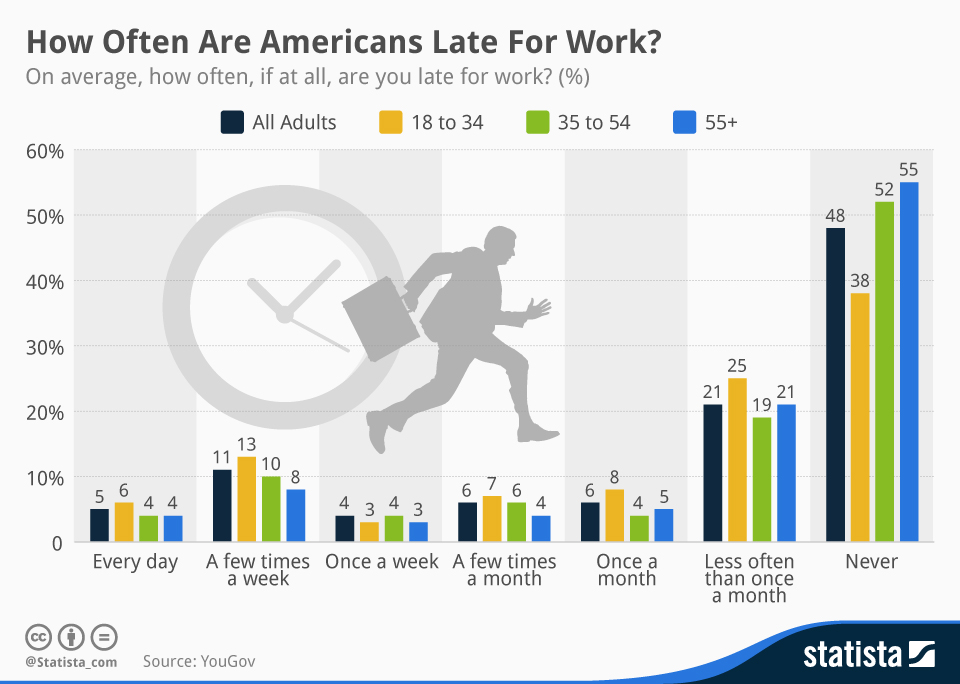


For full disclosure, I am a bit of a stickler for being on time, but stopped wearing a watch when I was about 16 to ‘free myself from the yoke of time micro-management’. Consequently, I developed the ability to estimate the time of day to within 15 minutes most of the time by a combination of dead-reckoning for the last known point and the height of the sun in the sky, for which my wife christened me ‘Chronos’. I still do not wear a watch, but instead carry a mobile phone that tethers me to micro-time management. The phone also tethers me in space and can give me and ‘optimum’ minimum time route from A to B.

Minimizing time may increase productivity but also ties our minds to the tick of the clock. Take your watch off, put your phone away (yes, I know it’s hard), do not look at a map, and navigate to your destination using signs, memory, and the sun. You will find unexpected places and connections, but stay safe. Expand your experience of time and space by removing the clock and map from the equation (Robbins, 2010).
Memory
Memory may be individual or collective. Individual memory is, on the whole, reliable, but how reliable depends on context, including the passage of time, the type of event, the interest of the person in the event, distraction, emotion, and how they are questioned (Ikier et al. 2022), as well as individual neurophysiology (Sheldon 2016). Our own memories are reasonably reliable as to how we experienced an event, but not the event as a whole. Collective memory is the shared pool of knowledge, beliefs, rituals, artifacts, and memories that a group of people hold in common and which give them identity. Collective memory is conditioned by context and internal forces just like individual memory.

A ‘memory map’ is a record of an individual’s or group’s experiences and memories of places and events. A memory map wary from simple sketches to Stephen Walter’s rich personal and historical narrative maps of London.


I became interested in memory through a class project making a memory map of Homs, Syria before, during, and after the civil war, and my interest in the late 18th-century geographer and explorer Alexander von Humboldt (1769-1859). The Homs Memory Map collates pictures and videos into a multimedia map, with media categorized as relating to peace (green), conflict (red), or reconstruction (purple), to provide a visual memory of a place now forever changed.

Alexander von Humboldt was once the most famous person in the world and probably has more things named after him than anyone else. He was lauded in his home country of Prussia, in South America, and the Caribbean, which he explored and made some of the first scientific evaluations of. On his return to Europe, he visited Thomas Jefferson at the White House and became a champion of its values. The United States then took Alexander to their hearts, with his ethos adopted as a model of scientific exploration, progress, and artistic endeavor. He led a rich, diverse life upon his return to Berlin and during the 20 years he was a resident of Paris, during which he published many well-received volumes of his travels and gave public lectures to great acclaim. His death was mourned around the world, and celebrations were held on the anniversaries of his birth and death.
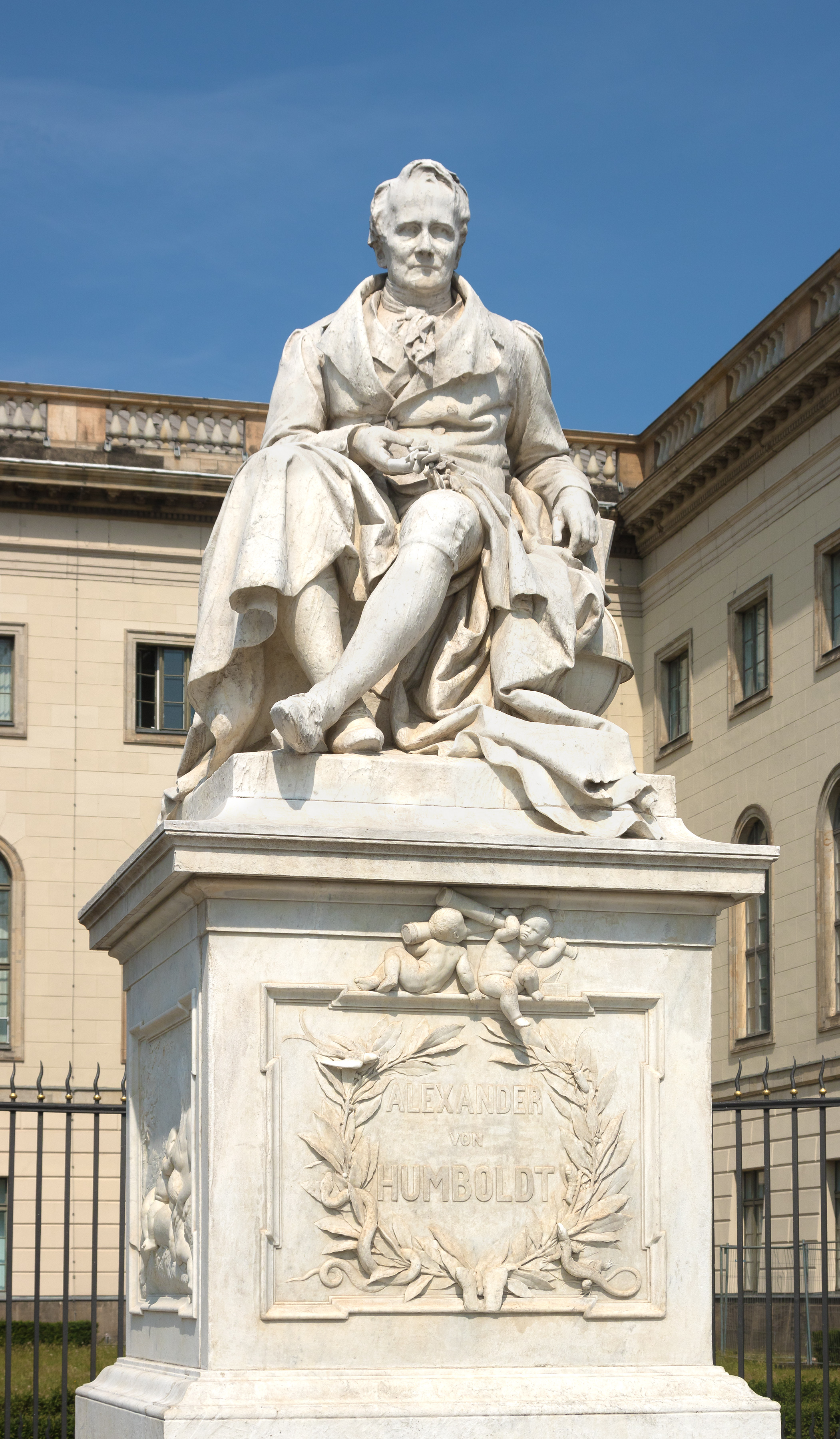
Collective memory, however, has faded from public consciousness over time, despite intermittent reversals, so I decided to map the spacetime geography of the collective memory of all the monuments to Alexander and things named after him. While there are records for some things being named directly in memory of Alexander, the origins of others are murky, or result from name ‘shifts’ in which things are named after other things in a locality or taxonomic hierarchy. For example, the New Caledonia cluster arises from species discovered on Mt. Humboldt being named after it, the Kerala and Sri Lanka cluster is a taxonomic cluster, and there are many things named ‘Humboldt’ in Humboldt County, California. Alexander may have been in the minds of taxonomists, whereas, in Humboldt County, the memory of Alexander is no more (Sachs 2007).


His memory goes in and out of fashion and spikes in significant years. Initially, memorialization was through the naming of organisms and natural features, but then it became a popular name for mines as well as entering civic spaces as monuments and place names. Civic naming continued with educational establishments, particularly in Germany and Northern South America, where ‘Humboldt schools’ follow principles derived from Alexander and, importantly, his older brother Wilhelm, who was instrumental in founding the German education system. Memorialization primarily continues through taxonomic and educational naming, but taxonomists are a relatively small enclosed community, and Humboldt schools may ‘inherit’ the name from being part of an organization. Humboldt may be the most memorialized person by number and variation of things, but his memory has faded with passing time.
It is interesting to contrast Humboldt to Charles Darwin (1809 – 1882) who carried the seven volumes of Humboldt’s Relation historique du voyage aux régions équinoxiales du nouveau continent (published 1814-1825) with him on the Beagle. Darwin is remembered today for his theory of evolution which connects living organisms in time and shattered religious-based notions of a special relationship with God. From our perspective, it may seem obvious that Darwin was destined to be lauded following the 1859 publication of the Origin of Species, but this was not always the case. Darwin fell out of fashion in the early 20th century, with Humboldt briefly getting more mentions in literature than Darwin in 1921-22.

Evolution, and hence Darwin, is quite wrongly associated with ideas of ‘superiority’ and ‘progress’ that align with capitalist agendas of ‘free-market’ competition and ‘growth’. It may be that a shift to a more sustainable world that is socially conscious and considers the world as interconnected systems may yet re-kindle Humboldt’s memory.
Personification
Time is personified as gods that may be linked to features in the landscape, in particular rivers.
Linear time
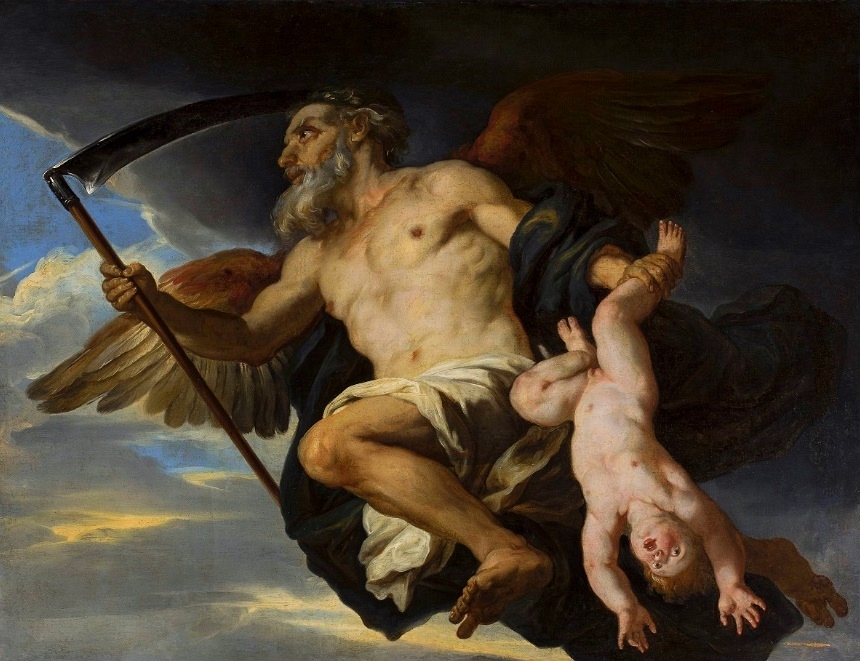
We have already met the Fates who control destiny, but there are many other gods and spirits with temporal personas. In Greek mythology, Chronos is a personification of linear time, who turns the heavenly zodiac wheel that impacts lives in negative and destructive ways. Famously, he ate his own children to prevent his usurpation, as he had usurped his father Uranus. In the Renaissance, Chronos morphed into ‘Father Time’ and the ‘Grim Reaper’ with hourglass and reaping scythe. Today, the Reaper has almost eradicated Old Father Time, but he still stands over Lord’s Cricket Ground where a game rich in both experienced and symbolic time from the excitement and boredom of the game to its association with England’s eternal ‘septured isle’ of Empire.



Cyclic time
Aion (from the Greek αἰών, long period of time’) was a Hellenitic deity of cyclic and ritual time. Below, Aion is depicted as a young man with wings attached to his temples, standing in the circle of the zodiac, with Terra and four putti representing the seasons.


Hinduism and Buddihism conceptualise time as a moving wheel, but with the linear eternal empasis lies on never-ending cycle – “begins to end and ends to begin” (Das 2018). The Kalachakra or ‘wheel of time’ is created by God to create divisions and movement in life and the ‘illusion’ of life and experienced time. Each cycle has four great epochs, Satya Yuga, Treta Yuga, Dwapar Yuga and Kali Yuga. Overcoming the illusion of life and death we become immortal being reborn in this world again.


Rivers
Rivers have long been associated with time (Ackroyd, 2007). They begin at their source and end at their mouth, between which they inevitably flow. First a trickle; then a fast-flowing upland brook; a meandering middle age; and finally, a broad estuary. They adjust their flow adapting to obstacles encountered along the way, and in doing so change the landscape in their wake. They feed and water us, do work for us, and give us pleasure, but may also be dark and dangerous. They are a metaphor for time, and personal and collective history.
A few miles from where I live, the River Thames at Hampton Court from where the river snakes its way east through London to the old Docklands and then to the sea where it is absorbed. The river is personified as the river god ‘Old Father Thames’ who carries a tridant not a scythe. He changes as the river does, be it providing river god, wretched denizen, and benevolent overseerer of fun. I grew up in East London but live now upstream to the west. If I walk a few hundred meters from my workplace and stand on the river bank the river flows downstream into the future, but where it is flowing takes me to my past.


Mortality
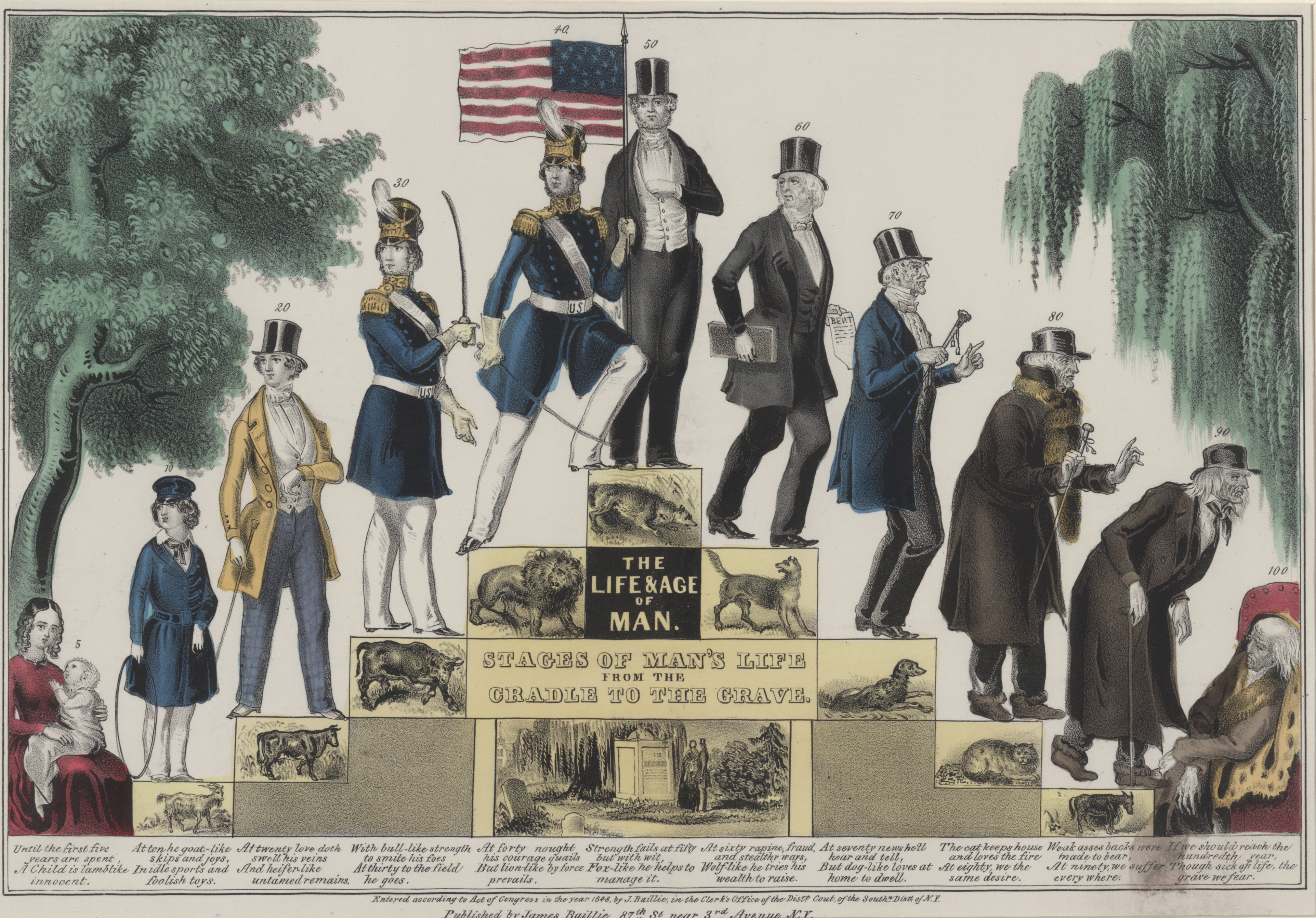
Father Time and the Grim Reaper personify how our lives are bound by birth and death and how life itself is fleeting and diverse, however ordered James Ballie thought it should be. We are all mortal, so far. Birth may be ecstatic and death may be serene; unfortunately, this is not always the case. Unless you believe in reincarnation, birth and death bookend our lived lives, our lives ripple on in the memory of others, documents, and data.

We all have direct experience of ageing and how ‘times change’ but other systems change over time-scales outside of lived-experience or collective memory. Mountians ranges and rivers may seem to have exister forever, but they have not. Mountains rise with the clashing of tectonic plates, while rivers follow their topography, changing direction as the surface rises or falls, simultanesously eroding the landscape and depositing sediment. We know this from empirical measurements of spatial and temporal pattern in the modern landscape, combined with conceptual interpolation of observed processes, and mathematical modelling.

Complex objects such as people and mountain ranges are bounded in space and time, ableit fuzzily. When something decays, the matter and energy it contains is conserved, either recycled back into the system or transferred to another system.

A Very Brief History of Time
Concerned with the physical aspects of time.
What is time?
Aristotle to Einstein
‘What is time’ is one of the great unanswered questions (Emery et al. 2024). Aristotle (384 – 322 BC) believed time required motion (idib.). Newton (1643 – 1727) regarded space and time to be separate and absolute (unending); space is occupied by bodies and time flows through both whether there is movement or not (Rynasiewicz 2022). In the late-19th and early-20th centuries, the nature of time continued to be questioned, particularly how it relates to space, but new questions began to be asked about our ‘experience’ of time, from individual experience to the increasing pace of city life and the impact of ‘deep’ geological time and evolutionary theory (Thomas 2023). At the same time, these questions were also becoming of wider interest to artists, including the cubist, futurist, surrealist, and kinetic art movements (Nebhan 2021), writers (Richardson 2006), and spiritualists (Schubert 1893) who believed in other dimensions and realms that intersect with our own. Einstein (1879 – 1955) came to the revelation that time was relative to space and depending on where you are and how fast you are going, but in quantum mechanics time remains universal and absolute, and thus remains an enigma is how it operates and what it is.

Post-Einstein
In the 1920s, Edwin Hubble’s measurements of the velocity and direction at which stars are moving relative to us demonstrate that the Universe is currently expanding (Veneziano 2006). In the 1960s, Stephen Hawking and Roger Penrose proposed that given these observations and Einstein’s equations, the Universe (and hence time and space) came into existence 13.7 billion years ago in the ‘Big Bang’ from a single ‘singularity’ of infinite density and temperature. Evenness of cosmic microwave background radiation, however, shows that the Universe has very similar properties throughout, which is contrary to predictions. To account for this unexpected evenness at large scales, an early period of rapid inflation was proposed, but alternative models in which the early universe was much smaller or much older than in standard cosmology are alternative possibilities. Theoretical and experimental research in spacetime continues, including loop quantum gravity and string theory, and the Laser Interferometer Gravitational-Wave Observatory that measures gravitational waves (idib).
While most agree the Universe began in a Big Bang, its future is less certain. Previous measurements suggest the rate of expansion is increasing, but data from the Hubble and James Webb space telescopes provide new support for Hubble’s constant ‘coasting universe’ (European Space Agency 2024). What came ‘before’ the Big Bang is either a non-question as it created time as we know it, or opens the possibility of a Universe ‘bouncing’ between singularities and multiverses. We may not know what time is, but that does not prevent us from measuring it.

Measuring time
Heisenberg’s uncertainty principle limits our ability to measure time to ‘Planck time’ with a duration of ~5.39 x 10-44 seconds. Planck time is not necessarily a physical minimum unit, but is the point at which our equations break down. The measurement of length is similarly limited to the Planck length of ~1.6299 x 10⁻³⁵ meters (Vagabond 2019). Planck time is so short we have no means of calibrating it to experience; it is an ‘other time’.
Temporal scale and values
Time may be recorded against a continuous or ordinal temporal scale. Universal Coordinated Time (UTC), the Common Era (CE), and Julian and Gregorian calendars are continuous temporal scales, whereas the International Chronostratigraphic Chart (ICC) is an ordinal geological scale with periods mapped to a continuous scale in which temporal precision (number of significant digits) decreases with age, while uncertainty increases.

Temporal measurements may be absolute or relative to a continious or ordinal temporal scale.
| I’ll be there… | Continious | Ordinal |
| Absolute | at 14:28, 11 June 2025 (UTC+1) | 10 minutes later than you |
| Relative | after 12:00 (UTC+1) | later than you |
Temporal values have precision e.g. (11/02/2025 or 02/2025) and uncertainty (‘on the dot’, ‘around’, ‘within an hour of’), but how is time measured?
Order
The most basic form of time measurement is ordering. Information on ordering can come from different sources including text and ‘natural temporal ordering’.
“There was to be an eclipse of the moon during the night, and the next day an occultation of alpha Virginis. The observation of the latter phenomenon might have been very important in determining the longitude of Carthagena”. – Alexander von Humboldt
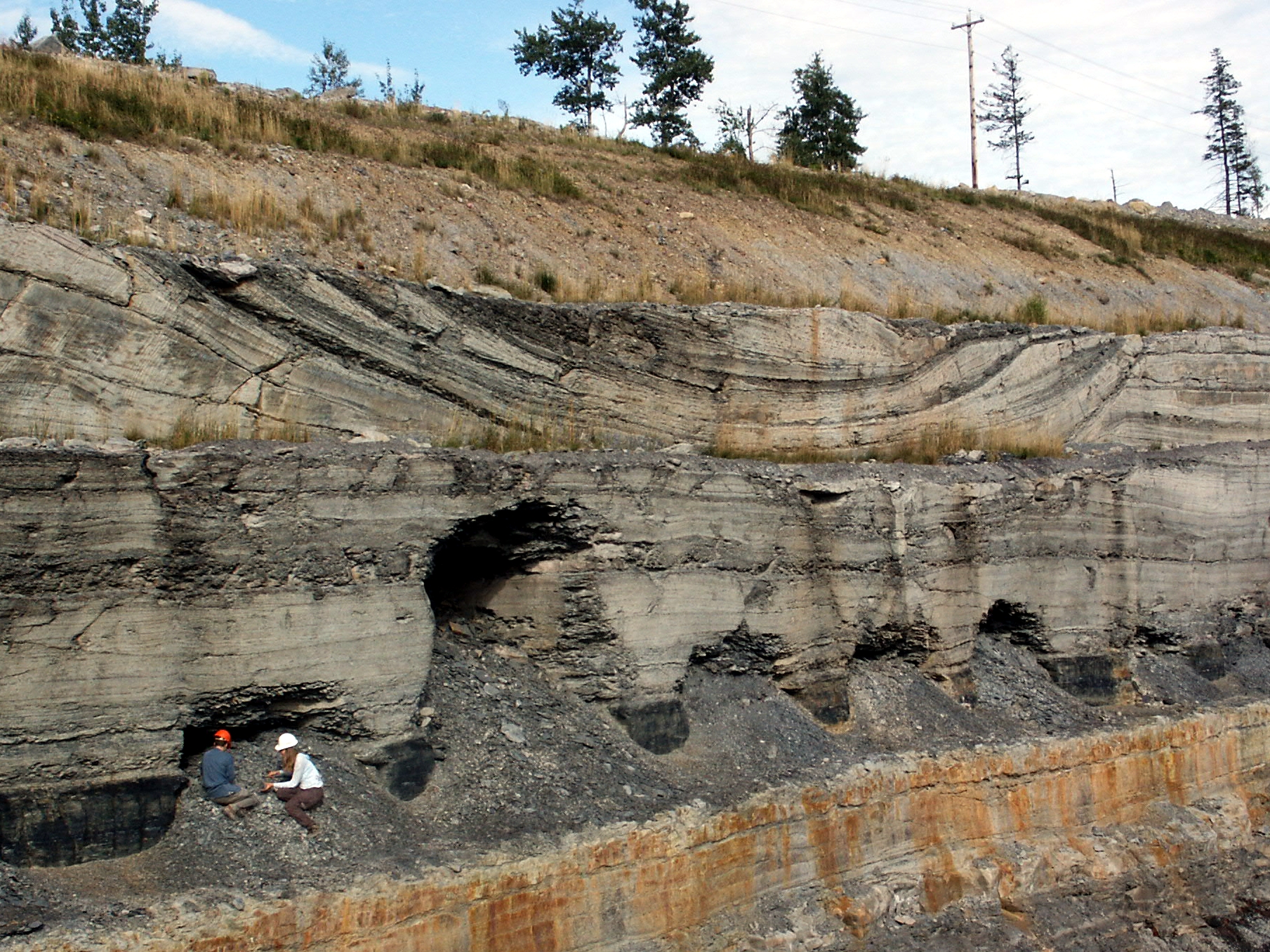
A sedimentry sequence is an example of natural temporal ordering as younger rocks are deposited on top of older rocks and features that ‘cut through’ older rocks such a palaeochannel cutting must be younger than the cut sediments.
Logic can be applied to a set of events for with the ordering, or partial ordering, is known. For example, the diagram below shows five undated evolutionary trees with small multiple maps at nodes showing ‘line of disjunction’ between geographically distinct descendent species ranges which are the hypothesised location of speciation. The sequence of spatially concordant events across all trees can be used to deduce event order.

Direct measurement
Humans have directly measured time using a great variety of devices and techniques for thousands of years (Longstaff 2005). Sundials and water clocks were first used in Egypt around 1200 BC, the hour-glass was invented in Europe in the 8th centuary followed by the first mechanical clocks in the medieval period, then the pendulum clock by Huygens in 1656. In the 18th century, improved clock design by the English clockmakers John Harrison and George Graham solved the longitude problem. The first electric clock was developed in 1840, followed by the quartz timer in the 1940s and atomic clocks in the 1960’s. For the last couple of decades most of us carried smart devices whose time is automatically set rather than requiring manual correction.

Proxy measurement
Historical time may be estimated using a wide variety of proxies – things that we observe or measure that are known to change in a specific way though time. Methods either provide an absolute data with statistic fit (e.g. 5.6 ±0.21 Ma) or classify to a time period (e.g the Early Bronze Age or Devensian/Weichselian glacial period).


‘Modern’ or ‘current’
If our experince of ‘now’ is in fact of the past, then all empirical data are historical records. There is no ‘real time’ data, just very quickly delivered data. Data that defines the ‘current or ‘present’ climate, econony, or anything else is always for a defined past time period. For example, ‘current climate’ is often a past 30-year period.

Data and information decay
We collect ever more data about us and the world and are told we are entering a phase of ‘big data’. Big data is great when it is available, but data on many topics is limited or does not exist. ‘Small data’ is common in historical studies as less data was collected in the past, some of what was collected has been lost or is degraded, while that which remains is locked in archive documents.


While we are getting better at recording metadata that describes a data set and preserving data in online repositories, data and information still reside with individuals as memory and notes. Information still remains may be lost through accident, neglect and our inevitable deaths.

Limited, low resolution data with high uncertainty restricts our ability to discover pattern and infer cause and effect and It is an inherent problem in historical studies where direct experience is impossible.
Space, time, geography, and history

“Geography is history in place, history is geography in time”
― Élisée Reclus (1830-1905).
(Paul Nadar, Public domain, via Wikimedia Commons)
History and geography take different perspectives on things and processes within space and time. History emphasises temporal pattern and processes, while geogaphy is primarily concerned with spatial pattern and processes, but all processes are inherently spatiotemporal as they involve the movement of matter and energy. Procesees redistribute matter and energy in space and time to form the celestial bodies, oceans, mountain ranges, forests, and us. They ‘bind’ geography and history, but what of space and time? In physics, space and time are binded by laws that define processes as mathematical formula. I think that two familiar equations with some reasoned implications, provide a conceptual model for understanding the relationships between time, space, geography and history.
- Velocity = Distance / Time. Rearranged to Distance = Velocity * Time, Galileo Galilei’s (1564-1642) equation of motion tells us the time an effect of a cause impacts a place depends on the distance and rate of movement. All spatial pattern must therefore be temporal, and all temporal pattern spatial.
- Intensity = 1 / Distance2. Johannes Kepler’s (1571-1630) inverse square law tells us that the intensity of event effect decays with distance with signal eventually being absorbed into the backgound. The impacts of events are therefore spatially localised.


Now consider events occuring in a space though time. At first events may remain isolated from one another, but they will soon begin to overlap. Pattern from older events is overlain, eroded, or distorted by later events, and the pattern created by new events (new history) is conditioned by pattern from older events (existing geography). Geographical landscapes are thus also ‘temporal’ landscapes made of parts of different age. Reconstructing past landscapes involves sifting and interpreting pattern in the current landscape.

Galileo’s equation of motion also has an important second implication, which is that processes that travel at the same velocity will propagate though a smaller spatial system quicker than a large space resulting in space-time scaling relationships between things and the processes operating on them.

It may seem audacious to reduce Reclus’s statement and scaling relationships to two simple equations and a thought experiment, for which I appologise. Nevethless, I find it an interesting way to think about the how space, time, geography, and history relate to one another at a basic level.
References
Ackroyd, P. (2008). Thames: Sacred River. Vintage.
Akkermans, E. (no date). A time before Greenwich Mean Time. Royal Museums Greenwich. https://www.rmg.co.uk/stories/time/time-greenwich-mean-time-confusing-case-travellers-watch
Adlam, E. (2022). Determinism beyond time evolution. European Journal of Philosphy and Science, 12, (73). https://doi.org/10.1007/s13194-022-00497-3
Balaguer, M. (2014). Free will. The MIT Press. https://mitpress.mit.edu/9780262525794/free-will/
Bruss, F. T., Rüschendorf, L., (2010). On the Perception of Time. Gerontology, 56(4). https://doi.org/10.1159/000272315
Emery, N., Markosian, N. and Sullivan, M., (2024). Time, The Stanford Encyclopedia of Philosophy , Edward N. Zalta & Uri Nodelman (eds.). https://plato.stanford.edu/archives/fall2024/entries/time/
European Space Agency (2024). Webb & Hubble confirm Universe’s expansion rate. https://www.esa.int/Science_Exploration/Space_Science/Webb/Webb_Hubble_confirm_Universe_s_expansion_rate
Ikier, S., Dönerkayalı, C., Halıcı, Ö. S., Kaymak Gülseren, Z. A., Göksal, H., & Akbaş, B. (2022). When is memory more reliable? Scientific findings, theories, and myths. Applied Neuropsychology: Adult, 31(1), 77–94. https://doi.org/10.1080/23279095.2022.210792
Libet, B. (1999). Do we have free will? Journal of Consciousness Studies, 6(8-9). https://www.ingentaconnect.com/content/imp/jcs/1999/00000006/F0020008/966
Longstaff, A., (2005). Calendars from around the world. National Maritime Museum. https://multifaiths.com/pdf/calendarshistory.pdf
Robbins, J. (2010). GPS navigation…but what is it doing to us?. 2010 IEEE International Symposium on Technology and Society, Wollongong, NSW, Australia, 2010, pp. 309-318, doi: 10.1109/ISTAS.2010.5514623.
Schubert, H. (1893). The Fourth Dimension. Mathematical and Spiritualistic. The Monist, 3(3). JSTOR, http://www.jstor.org/stable/27897087. Accessed 3 June 2025.
Sheldon, S. et al. (2016) Intrinsic medial temporal lobe connectivity relates to individual differences in episodic autobiographical remembering. Cortex, 74, pp. 206–216. Available at: https://doi.org/10.1016/J.CORTEX.2015.11.005.
Nebhan, K. (2001). The explosion of “time” in early twentieth century cubist, surrealist, futurist and kinetic art. Limina, (7), 113–124. https://search.informit.org/doi/10.3316/informit.305407364329474
Richardson, B. (2006), Making Time: Narrative Temporality in Twentieth-Century Literature and Theory. Literature Compass, 3: 603-612. https://doi.org/10.1111/j.1741-4113.2006.00321.x
Rynasiewicz, R. (2022). Newton’s Views on Space, Time, and Motion. The Stanford Encyclopedia of Philosophy, Edward N. Zalta (ed.). https://plato.stanford.edu/archives/spr2022/entries/newton-stm/
Sachs, A. (2007). The Humboldt Current. Oxford University Press.
Thomas, E. (2023). The obsession with time in 1880s–1930s American-British philosophy. British Journal for the History of Philosophy, 31(2), 149–160. https://doi.org/10.1080/09608788.2022.2093157
Vagabond, J. (2019). The Plank Units. John Vagabond’s Physics and Chemistry Blog. https://johnvagabondscience.wordpress.com/2019/03/02/the-planck-units/
Veneziano, G. (2006). The myth of the beginning of time. Scientific American. https://www.scientificamerican.com/article/the-myth-of-the-beginning-of-time-2006-02/