
Low-level design
Low-level design principles relate to the design and placement of graphic symbols and text. Symbols and text are differentiatiated from one another (high-level) by varying symbols along graphic dimensions (also known as retinal dimsions) such as shape, size, colour, font, and orientation, which encode attribute values. Which graphic dimensions are available and whether they produce ‘good’ outcomes depend on symbol type – point, line, area or text.
Symbols
Symbols represent ‘things’ in a graphic plot that may be points, lines, areas, or volumes. Information is encoded in the position and form of symbols (shape, size, colour, orientation, etc). The selection of approriate graphic symbols is an essential step in visualising data, but may be overlooked when default symbologies or a little fiddling produce a design that ‘work’ in respect of differentiating values but are not efficient and lack elegance.
Symbol types
Symbols may be classified by ‘form’ (abstract, pictorial and associative) and number of ‘symbol dimensions’ (0D – 3D) .

Abstract symbols are minimalist and culturally and emotionally neutral so are the norm in academic and technical visualisation. A disadvantage is low differentiation between symbols.
Pictorial and associative symbols are representations of, repectively, the ‘thing’ being represented (e.g. a traffic light) and something that it is closely associated with the thing (e.g. a tree and a park). Pictorial and associative symbols are highly discernable from one another and facilitate understanding without a key, so should be interpretable to diverse viewers, but interpretation may vary with demographic or culture. They are good for communication with a wide audience, but require more graphic space to display than abstract symbols and their cultural and emotional ‘baggage’ must be considered in relation to use.
Symbol dimensions
Point symbols are zero-dimensional, line symbols have one one dimensions, area symbols two, and volume symbols three dimensions.

Point, line, and polygon symbols may also be abstract, pictorial, or associative.


This diagram also reveals the context dependant and cultrually mutable nature of the abstract/representation/pictorial classification .
- A triangle is an abstract symbol except when used to represent something triangualar, in which case it is associative (the same holds for all shapes).
- Why is a dashed-line ‘associated’ with a ‘boundary’ but railroads are not ‘associated’ with a black line despite both being common on maps?
- I do not personally associate dots with marsh or indeed any other type of habitat.
- Pictorial representations are ultimately associative.
- Flags are flown over buildings that are not schools, and UK schools do not often fly flags.
- The ‘pictorial’ railroad symbol might be used for a trams (is a tram and railway the same thing?), and railway have two rails, unless a monorail. Similarly and highways more than one carriageway.
- Trees are only regularly spaced in plantations.
Visual dimensions
Visual dimensions (also retinal or visual dimensions) are the different ways a symbol can be varied to visually differentiate it from other symbols. Jacques Bertin (1967) proposed seven ‘retinal variables’ that descriminate point, line, and area symbols. The seven variables have now been been extended to include colour saturation, arrangement, crispness, resolution, and trasparency.

- Selective variables support the isolation of symbols based on a variation in that variable (e.g. spatial clusters and symbols displayed in the same colour). It is important to observe that selection by shape not possible despite our naive tendency to think it is.
- Associative variables support the grouping of symbols that vary in other dimensions (e.g. you can seperate yellow objects from other coloured object despite variation in shape).
- Ordered variables have a natural sequence (e.g. small/large or light/dark).
- Quanititative variables continiously scale, so can communicte actual values (e.g. x and y location on a graph or map).

Pictorial symbols vary in shape but may also vary in other dimesions. For example, by employing Chernoff faces coloured by racial mix.

Attribute level of measurement
Attributes have a ‘data type’ (integer, real, character, etc.) that defines how it is stored, and ‘level of measurement’ that defines ‘what sort of value’ it is, and what can be legitimately be done with it analytically and graphically.


Mapping attribute to visual dimensions
The designer must decide which variables/attributes to dispaly using which visual dimension(s). Cleveland and McGill (1984) assessed the utility of graphic dimensions for representing data at different levels of measurement using a mixed-method that combined quantitative measurement of reading accuracy and qualitative perception.


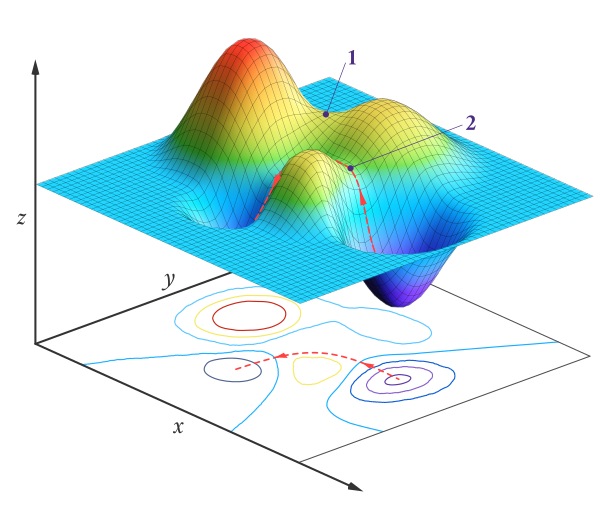
It is often a good idea to map attribute dimensions to a single graphic variable, however, mapping to more than one visual dimension can reinforce pattern. Here, potential energy is mapped to z-position and colour hue, and is also visualised as coloured 2D isolines.
In this word cloud, word frequency in mapped to text size with the most freqent words located towards the center of the figure.

Summary
Symbols have physical (0-3D) and visual dimensions, whereas data has attribute dimensions whose properties are defined by their level of measurement. Visual variables vary in the kinds of pattern (e.g. associate, selective) that can be visually extracted and how well they comminicate data with different levels of measurement, but ‘position’ is always the most accurate visual dimension so should be generally be used to communicate the most important variables.
Typography
Typography relates to the design and positioning text in visualisation or layout so that it is legible and appealing with fonts embueing an emotive character. Type may be differentiated along visual dimensions that include, font, size, capitalisation, and bolding and italics. The font or typeface, is the ‘shape’ of the text, with fonts that share similar characteristics grouped into font families, the most commonly used and easily defined being ‘serif’ and ‘sans serif’ fonts. Other font families include ‘monospaced’ (all characters have equal width) and ‘script’ which looks like handwriting, while families such as ‘decorative’ are more arbitary.

Font designs date back to the medieval period with sans serif fonts first being used in the early-19th century advertising, as they are perceived as ‘clean’, ‘modern’, and, importantly for advertising, readable at longer distances. San serif fonts are also more accessible to the partially-sighted and dyslexics. Equally-spaced monotype fonts were developed in the 1890’s by the Monotype company are useful for computer code, tables, or other situation when text should be aligned. Sans serif fonts are recommended, or may be required, for scientific and other graphics where the message is paramount over affective design.
Serif fonts can give a impression of age. In this poster, I used the serif Constatia font to remincient of 19th century books for the title and main text, with the title italic to evoke hand-written notes and correspondance. Figures and their titles use the sans serif Arial font for readability and as designed for inclusion in an academic paper. The ‘historic’ aesthetic given by the font is mirrored in the old and slightly discoloured paper texture and the wood-style frame suggesting it has been hung on a wall for some time.

Text dimensions
Text may be differentiated along several dimensions.

Font and colour are most approriate for distinguishing nominal categories, while size, boldness and case can be used to signify order or importance.
Labels
Labels are used to communicate information that is not part of the graphic design, primarily ‘names’ and exact values. They are often associated with one or mores symbols, but are also used locate ‘regions’, such as mountain range on a map. Only features that need identifying should be labelled. Labels should designed and placed so that they visually group with the symbol and are legible. ‘Label engines’ are useful for postioning labels, but manual adjustment is often also required, especially in the greater the number and type of features displayed. The Geography Deparment at Penn State provide an excellent guide to cartographic label placement.
Labels must be legable with problems arising from choice of font and size, but is also from unavoidable overlap of labels and other graphics. Increasing the visual contrast of the label by increasing its size, boldness or other dimension may help, as may writing text in a box or giving it a halo.

Colour
The images we ‘see’ including colour are a mental representations of reality conditioned by our biology, psychology, culture, and context.
Colour space
A colour space is a system for defining colours within computer applications. There are several different colour spaces in which colours are defined by their coordinates in different colour-dimensions, with the most common being Red-Green-Blue (RGB), Cyan-Magenta-Yellow-Black (CMYK), and Hue-Saturation-Value (HSV). In the RGB space colour, colour is specified by three integers between 0 and 255 that define the amount of red, green and blue light to mix. Zero represents no light so [0, 0, 0] encodes white and 255, 255, 255 black; 255, 0, 0 is ‘pure’ red; 0, 255, 0 green; and 0, 0, 255 blue. Transparency is enabled through the addition of an ‘alpha’ dimension (also channel) to the colour space. The three HSV dimensions correspond to Bertin’s equivalent visual variables, but RGB is probably the most widely employed.

Hex codes
Hex codes are a convenient standard approch for defining colour that issimply the RGB value in hexadecimal (base 16). Hexcodes are supported by many software packages in which they may, or may not, be prefixed by a hash character ‘#’.

Palettes
Palettes are collections of colours designed for aethetically displaying different types of data that are either composed of discrete colours or generate a colour from a continuious distribution. The designer must select an approriate palette for the task.

Color wheel
Colour wheels are art and design tools that organise colours into groups based on relationships such as primary, secondary, and complementary colours. They let you understand how colours interact facilitating pallette selection. Pigment colour is ‘additive’ (combine to black) whereas colour in light is ‘subractive’ (combine to ‘white’), with the pure primary colours for which other colors are made being yellow, blue and red. Secondary colours are equal mixes of the primary colours. Intermediate colours are evenly spaced, analagous colours occupy part of the wheel, and complementary colours are lie of opposite sides of the wheel.

The Living Planet Index graph of decline of global abundance of three groups of organisms uses intermdiate colours from less than one-half the colour wheel to differentiate between groups and give a balance or harmony which attention-grabbing red might have destroyed. The different groups are drawn in ordered associative colors from blue marine, thorough blue-green freshwater, to green terrestrial groups. The global trend is purple, which is abstract in this context and is slightly thicker as the ‘most important’ information.

Grey is the new black
Pure black #000000 is a striking ‘colour’ that can lead eye strain. Dark grey’s result in ‘softer’ edges that reduce eye strain. Greys should also be considered for graphic axes and grid lines as these are context not data.

Experience, emotion, and culture
Colour affects our conscious and unconscious minds, eliciting attention and emotion modulated by cultural meaning. These experiential, emotional, and cultural aspects of colour may be employed to enhance a graphic; alternatively, if not considered or improperly implemented, they may result in undesired consequences.
Bright colour against a muted background attracts our attention.

The UK National Landcover Map uses ‘naturalistic’ colours to represent different categories. Coniferous forest is dark green, while decidious forest is displayed in a red reminscent of autumn colours that also attracts attention as an ‘important’ UK landcover that includes our few ancient forests. Grassland is light green mimicing lush pastures, and heather purple like its flower. Fen, marsh, and swamp in bright yellow is not naturalistic, but like decidious woodland is a nationally important habitat.

Ed Hawkins’ effectively employs the association between ‘red’ and ‘hot’, and ‘blue’ and ‘cold’ in his Climate Stripes visualisation of climate change.

Colour is associated with emotion. There are many infographics that connect colour an emotion especially in relation to company branding and how the logos of Fortune 500 companies signify ‘trust’ and ‘excitement’ over ‘peace’ and ‘balance’.


Colour meaning is also conditioned by culture sometimes having multiple connotations. For example, red is linked to love, fertility, good fortune, happiness, and celebration, but also, warning, war, destruction, sex, sin, prostitution, and murder (Yu 2014).

Context
Colour varies with its surrounding context and the context in which it is viewed. The former may be familiar from optical illusions. As an example of how surrounding context effects colour perception, the small squares are the same colour, but its apprearance changes in the context of the surrounding colour.

We experience how colour is effected by light condition every day of or lives, for example the dulling of colour when light levels are low, and the colored illumination of buildings at night.

Accessibility
Colourblindness, or more correctly ‘impared colour vision’, affect 6-10% of males and 0.4-0.7% of women (Gordon 1998), whereas rates of other visual imparement (high short and long sight, partial sight, and blindness) varys considerably from <0.5% in Germany Wolfram, C. et al. (2019) to 7-10% in indiginous Brazialians (Fernandes, A. et al. 2021). How colour vision is impared depends on which cone cells in the retina of the eye are not functioning.
| Colour imparement | Red cones | Green cones | Blue cones | Effect |
| Trichroma | Yes | Yes | Yes | Full colour vision |
| Deuteranope | Yes | No | Yes | Green looks red |
| Protanopia | No | Yes | Yes | Red appears dull green |
| Tritanomaly/ Tritanoma | Yes | Yes | No | Blue appears green |
| Monochromacy | No | No | No | No colour Monochrome |


There are many colour-blind friendly palletes and image testing tools available to help you make accessible graphics including:
While accessibility should always be considered and accommodated in any graphic design where practical, strict adherence to guidelines limits the palette of colour and other design options, such line thickness and text size and font, reducing the amount of information that can be displayed and its aethetics to the majority of the population without visual imparement.
Summary
Humans are ‘visual creatures’ who are inherently aware and attracted to colour. It is easy to get it ‘wrong’, but it only takes a little effort to get ‘right’. The first thing you should ask yourself is whether it is necessary or could the figure be produced in black and white or greyscale? Environmental and monetory cost should be considered as both are less without colour. Presuming colour is required a palette should be selected based on the purpose of the visualisation taking into account their expirential, emotional, and cultural aspects in the use context. It is easy to ‘over-do’ colour- too much and too ‘bright’. Muted colour is less ‘strident’ than pure colour, but stridence is required to stand out. Off-the-shelf palettes designed to meet specific purposes should be considered as they have already been optimised, but these may not adequately meet needs. Making you own palette is not hard especially with hex codes.
References
Bertin, J. (1967): Sémiologie graphique. Paris.
Cleveland, W.S. and McGill, R. (1984) “Graphical Perception: Theory, Experimentation, and Application to the Development of Graphical Methods,” Journal of the American Statistical Association, 79(387), pp. 531–554. Available at: https://doi.org/10.2307/2288400.
Gordon, N. (1998) “Colour blindness,” Public Health, 112(2), pp. 81–84. Available at: https://doi.org/https://doi.org/10.1038/sj.ph.1900446.
Fernandes, A. et al. (2021) “Visual impairment and blindness in the Xingu Indigenous Park – Brazil,” International Journal for Equity in Health, 20. Available at: https://doi.org/10.1186/s12939-021-01536-w.
Mackinlay, J. (1986) “Automating the design of graphical presentations of relational information,” ACM Trans. Graph., 5(2), pp. 110–141. Available at: https://doi.org/10.1145/22949.22950.
Pánek, J. (2020) “Spatial Visualisation,” in V. Pászto et al. (eds) Spationomy: Spatial Exploration of Economic Data and Methods of Interdisciplinary Analytics. Cham: Springer International Publishing, pp. 207–219. Available at: https://doi.org/10.1007/978-3-030-26626-4_9.
Wolfram, C. et al. (2019) “The Prevalence of Visual Impairment in the Adult Population,” Deutsches Arzteblatt International, 116(17), pp. 289–295. Available at: https://doi.org/10.3238/arztebl.2019.0289
Yu H C. (2014). A cross-cultural analysis of symbolic meanings of the color. Chang Gung Journal of Humanities and Social Sciences, 7(1): 49-74.